|
Home
Introduction
to NOUFORS
What's
New
Products
Michel
M. Deschamps - Director
Personal
Sightings
Sightings
Archive
Newspaper
Archive
UFOs
UFO
Characteristics
UFO
Physical Traces
Animal
Mutilations
UFO
Occupants
Crop
Circles
Audio
Clips
Documents
Majestic-12
Politicians
and UFOs
Military
Officers
and UFOs
Scientists
and UFOs
Astronauts
and UFOs
Pilots
and UFOs
Cops
and Saucers
Celebrities
and UFOs
Who's
Who in
UFOlogy
Encyclopedia
of Terminology and Abbreviations
Kidz'
Korner
Links
Recommended
Reading
Recommended
Viewing
|
|
|
Leading
Skeptics and Debunkers
Ufology
may have its proponents, but it also has its opponents.
The field of UFO research is filled with experts that
are very reputable, highly educated and extremely knowledgeable
about UFOs, Flying Saucers and related matters.
But
also added to the mix are those people whose skepticism
remain unshaken. No matter what evidence you present
to them, they will throw out any bit of information
that doesn't fit their pre-conceived ideas and theories.
Debunkers will even go further and tell you what you
saw...instead of listening to what you, the eyewitness,
actually saw with your own eyes!
RULES
FOR UFO DEBUNKERS:
1.
Don't bother me with the facts, my mind is made up.
2. What the public doesn't know, I am not going to tell
them.
3. If you can't attack the data, attack the people.
It's easier.
4. Do research by proclamation because investigation
is too much trouble.
COROLLARIES:
•
Absence of evidence is evidence of absence because looking
is too much trouble.
• All Believers are liars.
• All Non-believers only tell the truth.
• Believers are only involved for the money.
• Non-believers turn over their money to charities.
• The proper way to do UFO document research is
from one's
armchair. Archival visits are too much trouble.
• Defame dead people since one can't be sued for
Libel.
• Of course TOP SECRET CODE WORD (ULTRA, UMBRA,
MAJIC, etc) material would be referred in Confidential,
Secret or TOP SECRET documents.
• Only the Roswell newspapers had relevant material.
Below
is a list of the leading skeptics and debunkers, past
and present, who have proclaimed...and continue to proclaim...that
"there is nothing to UFOs", but have yet to
do the research on a topic of which they know nothing
about.
|
|
|
|
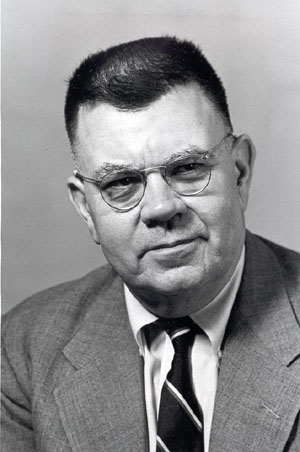
Dr.
Donald H. Menzel
Dr.
Donald Menzel (1901-1976) was a prominent Harvard astronomer,
serving as a professor of both astronomy and of astrophysics.
He was also the chairman of Harvard College Observatory
from 1954 to 1966. Menzel was a globally renowned astronomer,
participating in numerous international committees, leading
solar eclipse expeditions, and establishing solar observatories.
Menzel also debunked UFOs, authoring three books on the
subject: Flying Saucers (1953); The World of
Flying Saucers (1964); and The UFO Enigma: A Definitive
Explanation of the UFO Phenomenon (1977). Menzel's
disdain for the UFO subject and his published works have
been used by skeptics Phil Klass and Robert Sheaffer as
evidence that there is nothing to UFOs.
|
|
|
|
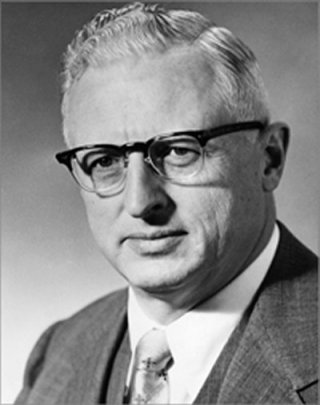
Dr.
Edward Condon
Edward
Uhler Condon was a distinguished American nuclear physicist,
a pioneer in quantum mechanics, and a participant in the
development of radar and nuclear weapons during World
War II as part of the Manhattan Project. The Franck–Condon
principle and the Slater–Condon rules are co-named
after him.
He
was the director of the National Bureau of Standards (now
NIST) from 1945 to 1951. In 1946, Condon was president
of the American Physical Society, and in 1953 was president
of the American Association for the Advancement of Science.
During
the McCarthy period, when efforts were being made to root
out communist sympathizers in the United States, Edward
Condon was a target of the House Un-American Activities
Committee on the grounds that he was a 'follower' of a
'new revolutionary movement', quantum mechanics; Condon
defended himself with a famous commitment to physics and
science.
Condon
became widely known in 1968 as principal author of the
Condon Report, an official review funded by the United
States Air Force that concluded that unidentified flying
objects (UFOs) have prosaic explanations. The lunar crater
Condon is named for him.
The
Condon Report
In
the late 1960's, the United States Air Force issued a
contract to the University of Colorado to carry out a
scientific study of evidence concerning the UFO phenomenon.
The director of the project was Prof. Edward U. Condon,
a distinguished and influential physicist who made no
secret of his opinion even at the outset that no substantive
evidence for extraterrestrial visitation was liable to
result. The study was relatively brief (2 years) and had
a notably low budget (app. $500K) for a serious scientific
study. When the Condon Report was released in 1968, the
American scientific community accepted its negative apparent
conclusion concerning evidence for extraterrestrial visitation
in a generally uncritical way, and to some extent even
an enthusiastic way since it offered an end to a troublesome
situation. An endorsement of the Report by the National
Academy of Sciences took place following an unusually
rapid review and the Air Force quickly used the Report
as a justification to terminate any further public involvement
with the topic of UFOs. Project Blue Book closed up shop.
The negative conclusion of the Report is more apparent
than real however, since there is a substantial discrepancy
between the conclusion in the "Summary of the Study"
written by Condon singlehandedly, and the conclusion one
could reasonably draw from the evidence presented in the
body of the Report. (Bernard Haisch, UFOSkeptic.org)
In
1968, Dr. Condon stated:
"Unidentified
flying objects are not the business of the Air Force."
|
|
|
|
Phil
Klass
The
late Philip Klass, an electrical engineer by education
and once the editor of the popular "Aviation Week",
was the most famous skeptic in modern times, having authored
five anti-UFO books and appeared on television countless
times. In his first book, "UFOs - Identified"
published in 1968, Klass suggested that, although terrestrial
of origin, many reported UFOs were strong evidence of
a new natural phenomenon which was similar in some ways
to ball lightning. His subsequent books then revealed
a complete reversal in his thinking. Klass had now adopted
the position (curiously, this "change of heart"
occured after his hypothesis on plasma balls had been
thoroughly discredited and rejected by scientists) that
the entire UFO phenomenon (including those cases Klass
first thought to be accurate and evidence for new phenomena)
was the result of, among others, hoaxes, and observational
mistakes.
|
|
|
|
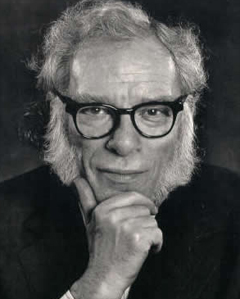
Isaac
Asimov
One
of the pioneers of Science Fiction, Isaac Asimov invented
or popularized many of the genre's tropes - Robot Buddies,
Galactic Empires, world-spanning cities - but is best known
for the Laws of Robotics and the Foundation Trilogy, both
early works. He is considered one of the "Big Three"
of Science Fiction along with Arthur C. Clarke and Robert
A. Heinlein, and was the owner of one seriously awesome
pair of sideburns.
Dr.
Asimov was a professor of biochemistry, member of Mensa,
and one of the most prolific writers of science fiction
and fact in history. He wrote 515 books as well as an uncountable
number of short stories and scholarly articles; his writing
spans nearly every subject a person can write about, including
a book about writing itself, a book of trivial facts about
whatever came to his head, and at least two joke books.
The prolific nature of his work was to the point where he
wrote a book in every Dewey Decimal System category except
for Philosophy (and technically, he is even in that category
too, though he only wrote the foreword to a book on philosophy
that was written by another author). His friend and fellow
author Peter David once joked, after Asimov's death, that
sooner or later a new book, ''Isaac Asimov's Guide to
the Afterlife" would be appearing in bookstores,
because if anyone could pull off a posthumous publishing,
it would be Asimov. In addition, he was a Promoted Fanboy;
he started reading the pulp sci-fi magazines sold in his
family's candy stores when he was young, began writing his
own stories when he was eleven, and managed to get published
when he was nineteen.
Robots
in early science fiction almost always Turned Against Their
Masters, a trope Asimov felt was ridiculous. Robots were
tools; they would be safe by design. After a few preliminary
stories, he formalized this with the Three Laws of Robotics:
• A robot may not injure a human being or, through
inaction, allow a human being to come to harm.
• A robot must obey orders given it by human beings
except where such orders would conflict with the First Law.
• A robot must protect its own existence as long as
such protection does not conflict with the First or Second
Law.
|
|
|
|
Ben
Bova
Benjamin
William Bova (born November 8, 1932) is an American author
of more than 120 works of science fact and fiction, six-time
winner of the Hugo Award, a former editor of Analog magazine,
a former editorial director of Omni (magazine), a past president
of both the National Space Society and the Science Fiction
Writers of America, and lives in Florida.
|
|
|
|
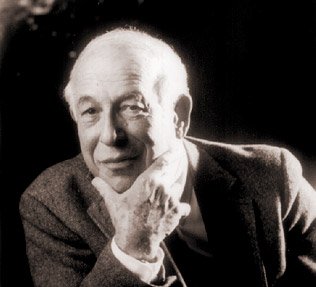
Sir
Arthur C. Clarke
Sir
Arthur Charles Clarke, CBE, FRAS (Sri Lankabhimanya Arthur
Charles Clarke) (16 December 1917 – 19 March 2008)
was a British science fiction writer, science writer, inventor,
undersea explorer, and television series host.
He
is perhaps most famous for being co-writer of the screenplay
for the movie 2001: A Space Odyssey, considered by
the American Film Institute to be one of the most influential
films of all time. His other science fiction writings earned
him a number of Hugo and Nebula awards, along with a large
readership, making him into one of the towering figures
of the field. For many years, he, along with Robert Heinlein
and Isaac Asimov, were known as the "Big Three"
of science fiction.
Clarke
was a lifelong proponent of space travel. In 1934, while
still a teenager, he joined the British Interplanetary Society.
In 1945, he proposed a satellite communication system —
an idea that, in 1963, won him the Franklin Institute's
Stuart Ballantine Medal. Later, he was the chairman of the
British Interplanetary Society from 1946–47 and again,
in 1951-53.
Clarke
was also a science writer, who was both an avid popularizer
of space travel and a futurist of uncanny ability, who won
a Kalinga Prize (award given by Unesco for popularizing
science) in 1961. These all together eventually earned him
the moniker "prophet of the space age".
Clarke
emigrated to Sri Lanka in 1956, largely to pursue his interest
in scuba diving. That year, he discovered the underwater
ruins of the ancient Koneswaram temple in Trincomalee. He
lived in Sri Lanka until his death. He was knighted by Queen
Elizabeth II in 1998 and was awarded Sri Lanka's highest
civil honour, Sri Lankabhimanya, in 2005.
On
paranormal phenomena
Early
in his career, Clarke had a fascination with the paranormal
and stated that it was part of the inspiration for his novel
Childhood's End. Citing the numerous promising paranormal
claims that were shown to be fraudulent, Clarke described
his earlier openness to the paranormal having turned to
being "an almost total sceptic" by the
time of his 1992 biography. During interviews, both in 1993
and 2004–2005, he stated that he did not believe in
reincarnation, citing that there was no mechanism to make
it possible, though he stated "I'm always paraphrasing
J. B. S. Haldane: 'The universe is not only stranger than
we imagine, it's stranger than we can imagine.'"
He described the idea of reincarnation as fascinating, but
favoured a finite existence.
Clarke
was well known for his television series investigating paranormal
phenomena Arthur C. Clarke's Mysterious World (1980),
Arthur C. Clarke's Mysterious Universe (1985) and
Arthur C. Clarke's World of Strange Powers (1994),
enough to be parodied in an episode of The Goodies in which
his show is cancelled after it is claimed he does not exist.
|
|
|
|
Dr.
Carl Sagan
Astronomer,
educator and author, Sagan was perhaps the world's greatest
popularizer of science, reaching millions of people through
newspapers, magazines and television broadcasts. He is
well-known for his work on the PBS series Cosmos, the
Emmy- and Peabody-award-winning show that became the most
watched series in public-television history. It was seen
by more than 500 million people in 60 countries. The accompanying
book, Cosmos (1980), was on The New York Times bestseller
list for 70 weeks and was the best-selling science book
ever published in English. Carl Edward Sagan was born
Nov. 9, 1934, in Brooklyn, N.Y. At Cornell since 1968,
Sagan received a bachelor's degree in 1955 and a master's
degree in 1956, both in physics, and a doctorate in astronomy
and astrophysics in 1960, all from the University of Chicago.
He taught at Harvard University in the early 1960s before
coming to Cornell, where he became a full professor in
1971. Sagan played a leading role in NASA's Mariner, Viking,
Voyager and Galileo expeditions to other planets. He received
NASA Medals for Exceptional Scientific Achievement and
twice for Distinguished Public Service and the NASA Apollo
Achievement Award. His research focused on topics such
as the greenhouse effect on Venus; windblown dust as an
explanation for the seasonal changes on Mars; organic
aerosols on Titan, Saturn's moon; the long-term environmental
consequences of nuclear war; and the origin of life on
Earth. A pioneer in the field of exobiology, he continued
to teach graduate and undergraduate students in courses
in astronomy and space sciences and in critical thinking
at Cornell. The breadth of his interests were made evident
in October 1994, at a Cornell-sponsored symposium in honor
of Sagan's 60th birthday. The two-day event featured speakers
in areas of planetary exploration, life in the cosmos,
science education, public policy and government regulation
of science and the environment -- all fields in which
Sagan had worked or had a strong interest.
|
|
|
|
Robert
Sheaffer
A
member of CSICOP (Committee for Skeptical
Inquiry into Claims Of the Paranormal)'s
UFO subcommittee and author of several UFO debunking books.
As with Klass, Sheaffer remains vociferously active in
this department. Sheaffer feels that "sympathetic
consideration of UFO sightings" is not only "irrational"
but threatens a "new dark age." UFOlogy
of any sort, even a cautious methodological variety is,
in Sheaffer's estimation and his italics, "fundamentally
a reaction against science and reason."
|
|
|
|
Michael
Shermer
Michael
Shermer is the publisher of Skeptic magazine, the director
of the Skeptics Society, the host of the Skeptics Lecture
Series at Caltech, and an adjunct professor at Occidental
College. He is the author of Why People Believe Weird
Things (W. H. Freeman) that was widely and positively
reviewed and was on the Los Angeles Times bestseller list
as well as nominated as one of the top 100 notable books
of 1997.
|
|
|
|
(The
Amazing) James Randi
James
Randi is a retired professional magician ("The Amazing
Randi"), author, lecturer, amateur archaeologist/astronomer.
Born in 1928 in Toronto, Canada, where he received his
high school education. He was naturalized a U.S. citizen
in 1987, and now lives in Florida. He is single.
He
was a founding fellow of the Committee for the Scientific
Investigation of Claims of the Paranormal (CSICOP) based
in Buffalo, NY. This organization of academics and other
experts is devoted to the examination of paranormal, occult
and supernatural claims. Nonprofit, it serves the media,
other scientific groups, and the public as an information
source. Their journal is the Skeptical Inquirer, which
reaches 40,000 subscribers. Mr. Randi also writes a column,
“'Twas Brillig,” for The Skeptic, the journal
of the Skeptic's Society, headquartered in California.
He is editor of SWIFT, the online newsletter of the James
Randi Educational Foundation (JREF) – to be seen
at www.randi.org.– which was set up in 1996 in Fort
Lauderdale, Florida, as a data source for educators, students,
media, and researchers. The SWIFT web page receives thousands
of hits a day from all over the world. The Foundation
offers prizes and scholarships to students, conducts seminars
and workshops, and also funds and originates selected,
original parapsychological research. The JREF also offers
a million-dollar prize – details to be found on the
web page. An annual conference – The Amaz!ng Meeting
– is held annually in January, featuring international
speakers on a variety of topics.
|
|
|
|
James
Oberg
James
Edward Oberg (born 1944) (often known as Jim Oberg) is
an American space journalist and historian, regarded as
an expert on the Russian space program.
After
service in the US Air Force, he joined NASA in 1975, where
he worked until 1997 at Johnson Space Center on the Space
Shuttle program. He worked in the Mission Control Center
for several Space Shuttle missions from STS-1 on, specialising
in orbital rendezvous techniques. This culminated in planning
the orbit for the STS-88 mission, the first International
Space Station assembly flight.
During
the 1990s, he was involved in NASA studies of the Soviet
space program, with particular emphasis on safety aspects;
these had often been covered up or downplayed, and with
the advent of the ISS and the Shuttle-Mir programs, NASA
was keen to study them as much as possible. He privately
published several books on the Soviet (and later Russian)
programs, and became one of the few Western specialists
on Russian space history. He speaks English, French, and
Russian and has used his language skills and a friendly
demeanor to gain access to the heart of the Russian and
European space establishments. (As a result, he has often
been called to testify before the US Congress on the Russian
space program.)
In
the 1990s, Oberg authored Space power theory, sponsored
by United States military as a part of an official campaign
in changing perceptions of space warfare, specifically
deployment and use of weapons in outer space, and its
political implications. In Oberg's view, "space
is not an extension of air warfare but is unique in itself."
As
a journalist, he writes for several regular publications,
mostly online; he was previously space correspondent for
UPI, ABC and currently MSNBC, often in an on-air role.
He is a Fellow of the skeptical organization CSICOP and
a consultant to its magazine Skeptical Inquirer. In 1991,
PBS transformed his book Red Star In Orbit into a documentary
series. HBO has optioned Red Star in Orbit for some future
made-for-TV miniseries. At about the same time Oberg launched
a six-year battle for official recognition of Robert Henry
Lawrence, Jr. (1935–1967) as a United States astronaut;
United States Air Force officially recognized Lawrence
in January 1997.
He
was commissioned by NASA to write a rebuttal of Apollo
Moon landing conspiracy theories. NASA later dropped the
project; however, Oberg has said that he still intends
to pursue it.
|
|
|
|
James
McGaha
James
McGaha is a retired USAF pilot, astronomer and director
of the Grasslands Observatory. He held a TOP SECRET
compartmented security clearance and was involved in
numerous classified operations including operations
in the so-called "Area 51." His current work
includes astrometry and photometry of asteroids and
supernovae. He has discovered 15 Asteroids and 52 Comets
and has over 1700 M.P.E.C. publications on Near Earth
Asteroids. He is the winner of the 2002 Shoemaker NEO
Grant. He has appeared widely in the media, having actively
promoted science and debunked pseudoscience for over
35 years, focusing on belief in UFOs and astrology.
He is the founder and chairman of the Tucson Skeptics
and a Scientific Consultant to the Committee for Skeptical
Inquiry.
In
this interview with D.J. Grothe, James McGaha talks
about his astronomer-beginnings as a skeptic of UFOs,
and the limitations of the term "UFO."
He answers how open-minded he is about the possibility
that extraterrestrial beings are visiting the earth
today. He talks about the origins of UFO belief with
the science fiction magazine Amazing Stories,
along with Fate, a magazine promoting paranormal
belief. He talks about the history of Project Bluebook
and the Condon Report. He details qualities of human
perception that may explain UFO accounts, and explores
some of the reasons people may adhere to UFO belief.
He explains the famous Phoenix Lights sightings. He
explores how to respond to those who have unshakable
belief in unsupportable UFO claims. He compares qualities
of contemporary UFO mythology with certain aspects of
religious belief, including views of apocalypticism
and salvation. And he talks about the dangers that belief
in UFOs pose to a civil society.
POI_2008_11_21_James_McGaha.mp3
|
|
James
McGaha provides his "expert opinion" on the 1997
Phoenix Lights case and the Stephenville, Texas UFO case
on the Larry King Live show:
http://www.youtube.com/watch?v=wSkXYmExOnA
|
|
|
|
Paul
Kurtz
Paul
Kurtz (born December 21, 1925 in Newark, New Jersey) is
best known for his prominent role in the United States
skeptical community. He has been called "the father
of secular humanism." He is Professor Emeritus of
Philosophy at the State University of New York at Buffalo,
having previously also taught at Vassar, Trinity, and
Union colleges, and the New School for Social Research.
Kurtz
has published of over 800 articles or reviews and has
authored and edited over 50 books. Many of his books have
been translated into over 60 languages world-wide. Among
his most important[citation needed] are "The Transcendental
Temptation," "Forbidden Fruit: The Ethics of
Secularism," , "The Courage to Become,"
and "Multi-Secularism: A New Agenda." His published
bibliography of writings from 1952 to 2003 runs over 79
pages.
Kurtz
founded the publishing house Prometheus Books in 1969.
He is also the founder and past chairman of the Committee
for Skeptical Inquiry (formerly the Committee for the
Scientific Investigation of Claims of the Paranormal (CSICOP)),
the Council for Secular Humanism, and the [Center for
Inquiry]. On May 18, 2010, he resigned from all these
positions. Moreover, the Center for Inquiry accepted his
resignation as chairman emeritus and board member, the
culmination of a years-long "leadership transition,"
thanking him "for his decades of service" while
alluding to "concerns about Dr. Kurtz’s day-to-day
management of the organization."
He
was editor in chief of Free Inquiry magazine, a publication
of the Council for Secular Humanism. He was co-president
of the International Humanist and Ethical Union (IHEU).
He is a Fellow of the American Association for the Advancement
of Science, and Humanist Laureate and president of the
International Academy of Humanism. As a member of the
American Humanist Association, he contributed to the writing
of Humanist Manifesto II. Former editor of The Humanist,
1967-78. The asteroid (6629) Kurtz was named in his honor.
|
|
|
|
Seth
Shostak
SETI
Institute Senior Astronomer
Seth
is an astronomer with a BA in physics from Princeton and
a PhD in astronomy from Caltech, and is involved with
the Institute's SETI research. But he's also responsible
for much of the outreach activities of the Institute.
He is science editor for "The Explorer", gives
more than 50 talks annually for both academic and general
audiences, and writes magazine articles (and books) about
SETI. He also teaches informal education classes on astronomy
and other topics in the Bay Area, and is the inventor
of the electrical banana, a circumstance he claims has
had little positive effect on his life. He is the host
for the SETI Institute's weekly radio program Are We Alone?
Before
coming to SETI, Seth did research work on galaxies using
radio telescopes at observatories and universities in
America and Europe. His avocations include photography,
filmmaking, and electronics.
Seth
has produced a series of lectures on tape and video on
the subject of SETI.
|
|
http://www.youtube.com/watch?v=461t299d2aw
|
|
|
|
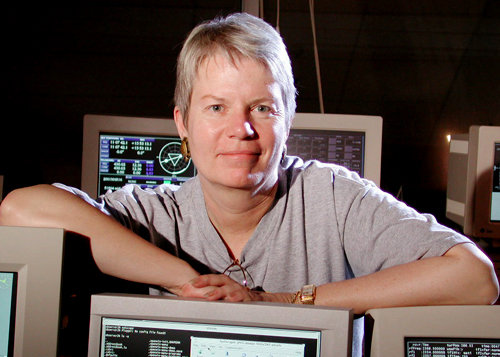
Dr.
Jill Tarter
Astronomer
Jill Tarter is Director of the Institute’s Center
for SETI Research, and also holder of the Bernard M. Oliver
Chair for SETI. She is one of the few researchers to have
devoted her career to hunting for signs of sentient beings
elsewhere, and there are few aspects of this field that
have not been affected by her work.
Jill
was the lead for Project Phoenix, a decade-long SETI scrutiny
of about 750 nearby star systems, using telescopes in
Australia, West Virginia and Puerto Rico. While no clearly
extraterrestrial signal was found, this was the most comprehensive
targeted search for artificially generated cosmic signals
ever undertaken. Now Jill heads up the Institute’s
efforts to build and operate the Allen Telescope Array,
a massive new instrument that will eventually comprise
350 antennas, each 6 meters in diameter. This telescope
will be able to enormously increase the speed, and the
spectral search range, of the Institute’s hunt for
signals. A subset of the full array will begin operations
in the Fall of 2007.
Indeed,
being as much of an icon of SETI as Jill is, perhaps it
is not surprising that the Jodie Foster character in the
movie “Contact” is largely based on this real-life
researcher.
|
|
This
SETI scientist claims UFOs don't exist. Her evidence for
such a scientific conclusion? She claims to have attended
a single UFO lecture and once mistook the moon for a UFO.
How does an astronomer holding a chair at SETI mistake the
moon for a UFO?! That says it all about her qualifications
in determining UFOs don't exist. So much for being scientific
and looking at the evidence. Jill, you should put your Ph.D
back in whatever box of Cracker Jacks you got it from...
SEE: SETI
http://www.youtube.com/watch?v=--agYxSX0uc
|
|
|
|
Joe
Nickell
Joe
Nickell (born December 1, 1944) is a prominent skeptical
investigator of the paranormal. He also works as an historical
document consultant and has helped expose such famous
forgeries as the purported diary of Jack the Ripper. In
2002 he was one of a number of experts asked by scholar
Henry Louis Gates, Jr. to evaluate for authenticity the
manuscript of Hannah Crafts' The Bondwoman's Narrative
(1853–1860), possibly the first novel by an African-American
woman.[2]
Nickell
is Senior Research Fellow for the Committee for Skeptical
Inquiry (CSI) and writes regularly for their journal,
the Skeptical Inquirer. He is also an associate dean of
the Center for Inquiry Institute. He is the author or
editor of numerous books.
Nickell
holds B.A., M.A., and Ph.D. degrees from the University
of Kentucky. His Ph.D. is in English for graduate work
focusing on literary investigation and folklore.
Nickell
has worked professionally as a stage magician, carnival
pitchman, private detective, blackjack dealer, riverboat
manager, university instructor, author, and paranormal
investigator, as well as listing over 200 "personas"
on his website.
Nickell
has evaluated manuscripts and written works for authenticity,
including the purported diary of Jack the Ripper (which
he helped to reveal as a forgery), and Hannah Crafts'
mid-nineteenth century novel The Bondwoman's Narrative,
whose authenticity he supported.
The
protagonist of the 2007 horror film The Reaping is loosely
based on Joe Nickell. He was brought onto the set to consult
with actress Hilary Swank.
|
|
http://www.youtube.com/watch?v=UV7EhiJSidw
|
|
|
|
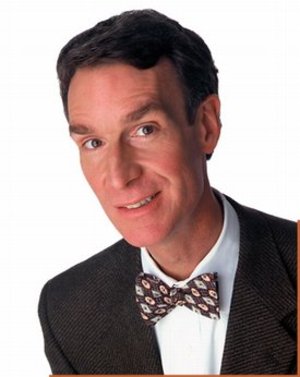
Bill
Nye (The Science Guy)
William
Sanford "Bill" Nye (born November 27, 1955),
popularly known as "Bill Nye the Science Guy",
is an American science educator, comedian, television
host, actor, and mechanical engineer. He is best known
as the host of the Disney children's science show Bill
Nye the Science Guy (1993–1998) and for his many
subsequent appearances in popular media as a science
educator.
Nye
is a fourth-generation Washington, D.C. resident on
his father's side of family. After attending Lafayette
Elementary and Alice Deal Junior High in the city, he
was accepted to the private Sidwell Friends School on
a partial scholarship, graduating in 1973. He studied
mechanical engineering at Cornell University, where
one of his professors was Carl Sagan, and graduated
with a bachelor of science degree in 1977. He was awarded
an honorary doctorate by The Johns Hopkins University
in May 2008. In May 2011, Nye was awarded an Honorary
Doctor of Science degree from Willamette University
where he was the keynote speaker for that year's commencement
exercises.
Nye
began his career in Seattle at Boeing, where, among
other things, he starred in training films and developed
a hydraulic pressure resonance suppressor still used
in the 747. Later he worked as a consultant in the aeronautics
industry. Nye told the St. Petersburg Times in 1999
that he applied to be a NASA astronaut every few years
but was always rejected.
He
is also a fellow of the committee for skeptical inquiry,
which represents many skeptics.
|
|
|
|
Stanton
Friedman appeared on the Scooter McGee show on 07-30-08.
Here he talks about confronting "UFO debunker"
Bill Nye off-camera on Larry King Live about Nye getting
facts wrong about the 1947 Roswell incident.
http://www.youtube.com/watch?v=A_GINgUmw54
Bill
Nye was out of his league on the Larry King show. Bob Jacobs
seemed more aggressive than usual; maybe that was because
of Nye's exhausted attempts at debunking.
http://www.youtube.com/watch?v=YsI1fmOsbt0&NR=1
|
|
|
|
Dr.
Michael Persinger
Michael
A. Persinger (born June 26, 1945) is a cognitive neuroscience
researcher and university professor with over 200 peer-reviewed
publications. He has worked at Laurentian University,
located in Sudbury, Ontario, since 1971.
Michael
Persinger was born in Jacksonville, Florida and grew up
primarily in Virginia, Maryland and Wisconsin. He attended
Carroll College from 1963 to 1964, and graduated from
the University of Wisconsin–Madison in 1967. He then
obtained an M.A. in physiological psychology from the
University of Tennessee and a Ph.D. from the University
of Manitoba in 1971.
During
the 1980s he stimulated people's temporal lobes artificially
with a weak magnetic field to see if he could induce a
religious state (see God helmet). He claimed that the
field could produce the sensation of "an ethereal
presence in the room". This research has received
wide coverage in the media, with high profile visitors
to Persinger's lab Susan Blackmore and Richard Dawkins
reporting positive and negative results respectively.
Dawkins reported a range of minor effects (relaxation,
sensations in his limbs, etc.), while Blackmore reported
"One of the most extraordinary experiences"
she had ever had.
Michael
Persinger has also contributed to research into the Miracle
of the sun at Fatima and other Marian apparitions. He
theorized that the stimulation of the cerebral-temporal
lobe may have been the actual cause of the Marian apparition
phenomenon. He believes the religious content of the experiences
may have been a result of their obsession with religious
themes and their lack of education. He has contributed
to 2 papers about The Miracle of the Sun.
Persinger
has also come to public attention due to his 1975 Tectonic
Strain Theory (TST) of how geophysical variables may correlate
with sightings of unidentified flying objects (UFOs).
Persinger argued that strain within the Earth's crust
near seismic faults produces intense electromagnetic (EM)
fields, creating bodies of light that some interpret as
glowing UFOs. Alternatively, he argued that the EM fields
generate hallucinations in the temporal lobe, based on
images from popular culture, of alien craft, beings, communications,
or creatures. In the UK, Paul Devereux advocates a variant
geophysical theory similar to TST, the Earthlights theory.
However, unlike Persinger, Devereaux generally restricts
such effects to the immediate vicinity of a fault line.
Devereux's approach also differs from Persinger's in holding
triboluminescence rather than piezoelectricity as the
"more likely candidate" for the production of
naturally occurring UFOs. Devereux doesn't advocate, as
in Persinger's TST, that the phenomenon might create hallucinations
of UFO encounters in people, instead proposing an even
more radical hypothesis: that earthlights may possess
intelligence and even have the ability to read witness'
thoughts.
UFO
researchers critical of the tectonic strain theory admit
that, while observations of diffuse lights during (and
sometimes before and after) very severe earthquakes may
give some weak support to some parts of TST and Earthlights
theory (see Earthquake lights), they question the ability
of fault lines to generate luminous effects and hallucinatory
experiences under much less severe conditions(as cited
above). Nonetheless, even TST critics such as Rutowski
think such theories may hold some promise for explaining
a small percentage of UFO phenomena, although they doubt
that they can ever offer a comprehensive explanation for
the vast majority of unexplained UFO cases. Other UFO
researchers (mainly in the U.K) believe this very limited
interpretation of the TST is brought into question by
the clustering of UFO reports within areas prone to faulting
- such as the Pennine region of northern Britain. While
acknowledging the drawbacks of Persinger's theory, they
feel that amended versions of it may account for a significant
proportion of "True UFO" reports.
Persinger's
claims regarding the effects of environmental geomagnetic
activity on paranormal experiences have not been independently
replicated and, like his findings regarding the God helmet,
may simply be explained by the suggestibility of participants.
|
|
http://www.youtube.com/watch?v=6lpyinT-Usc
|
|
|
|
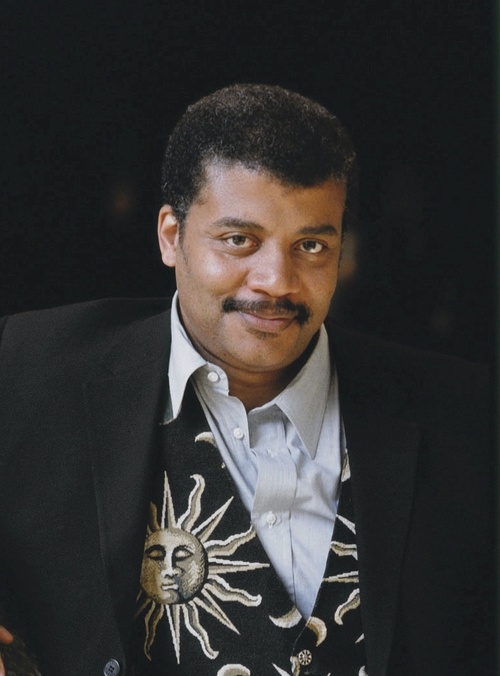
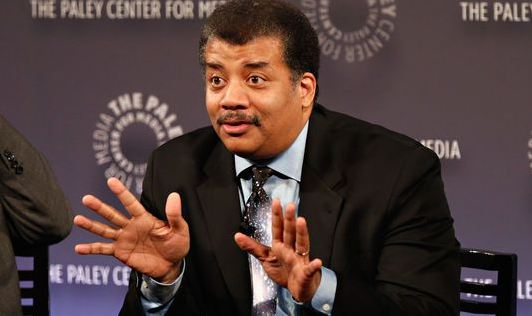
Dr.
Neil DeGrasse Tyson
John
Prytz (John Prytz)
Neil
DeGrasse Tyson's Philosophy On UFOs: Some Comments
Sooner
or later, nearly every astronomer, especially if they
have a relatively high public profile, has got to face
the UFO issue and expound upon whether there is any scientific
credibility to the idea that some UFOs are bona-fide alien
spacecraft. One such astronomer, Dr. Neil deGrasse Tyson
of the Hayden Planetarium, New York City, has indeed made
his point of view known. He doesn't deny the theoretical
possibility, but that is about as far as the credibility
goes. I take issue with some of his opinions as this essay
details.
When
it comes to the emotive subject of UFOs (as in alien spacecraft),
scientists just don't want to know or enter into the debate
if it can possibly be avoided, for the prime reason that
those who make the UFO = alien spaceship equation fail
to either put up or shut up. That's 'put up' in terms
of the sorts of evidence that scientists tend to have
to 'put up' when they make claims. If they have to 'put
up', they expect in turn that others will 'put up' evidence
to them. The scientific consensus is that UFO = alien
spaceship buffs haven't done an adequate job in the 'put
up' department. One such scientist with that point of
view (POV) is the fairly well known astronomer, Dr. Neil
deGrasse Tyson. While overall reasonably correct in that
POV, some of his arguments are flawed and lack credibility
in my POV.
Dr.
Neil deGrasse Tyson on UFOs.mp4
When
it comes to evidence for this or that explanation for
a UFO sighting, especially the UFO = alien spacecraft
explanation, eyewitness testimony is suspect. Or so relates
astrophysicist Dr. Neil deGrasse Tyson via several YouTube
clips relevant to his take on UFOs. But wait, there's
more!
Dr.
Tyson quite correctly points out that the "U"
in UFO stands for "unidentified" and that's
as far as anyone seeing, what to them is an Unidentified
Flying Object, can expound upon. One should not jump to
the conclusion that "U" equals alien spacecraft.
No argument there. However, he also points out, an equally
valid comment, is that we don't like mysteries like things
that are unidentified and so therefore we do tend to jump
the gun and jump to unwarranted conclusions in order to
identify the unidentified and maybe unidentifiable. No
argument from me there either other than to point out
that we leap to the conclusion of UFOs = alien spaceships
in favour of some other explanation probably because there
must be something suggestive of that possibility; there's
something in the observational date that points to alien
ships and not to something else.
He
notes that there exist natural phenomena and conditions
which can befuddle someone not familiar with those phenomena.
No argument on that observation either.
HUMAN
PERCEPTION
But
he goes slightly off the rails by suggesting the least
likely form of bona-fide evidence is human perception
or eyewitness testimony. Optical illusions are a case
in point as he delights in pointing out. However, relative
to man-made or designed optical illusions, there are not
all that many natural ones, although there are some of
course, like mirages or that 'sinking' ship as it passes
beyond the visible horizon.
I
get the impression from Dr. Tyson's comments that eyewitness
testimony has as much reliability as a $7 bill. Human
perception is absolutely 100% fallible. Although eyewitness
testimony is a cornerstone in legal proceedings, courtroom
lawyers have a field day in discrediting eyewitness testimony.
Experiments by psychologists prove overwhelmingly that
any sudden and unexpected event witnessed by ten people
will result in ten different versions of what happened,
but not drastically so. I mean ten witnesses will differ
on the height, weight and attire of the person in the
unexpected happening, but they won't differ on the fact
that it was a human and not an elephant!
Humans
are actually pretty good when it comes to the details,
otherwise why would law enforcement officials ask you
to point out the criminal in a police line-up or the news
reporters question witnesses to some unusual news happening?
To take just one of thousands of possible examples, you
can easily tell your face from your parent's faces and
from the face of every other person you know (in person)
or have frequently seen (like Dr. Tyson's on YouTube).
You know a new and different face when you see one. You
can tell a human face from say a reconstructed one of
Homo erectus. You can distinguish a primate face from
a feline face from a canine face from a bovine face. You
can tell apart the face of a penguin or an eagle from
their ancient ancestor, the T-Rex. If you can't tell apart
a frog face from a crocodile face from a shark face from
a spider's face, there's something seriously askew. Assuming
there's nothing askew; you can tell apart all these examples
of faces despite the fact that they are all faces.
Therefore,
in your day-to-day life, 99.9% of what other people tell
you they saw (i.e. - Joe Blow drinking down at the pub)
you'll believe them. Human perception is flawed, but it's
all you got for all practical purposes - despite zillions
of smart-phone cameras around snapping anything and everything.
People don't tend to tell you they saw Joe Blow at the
pub AND show you their smart-phone camera picture of Joe
Blow at the pub since you obviously wouldn't believe them
without the pictorial backup.
In
any event, perception in humans usually tends to be more
than adequate, say when driving a car or playing a game
of baseball. Humans have an excellent innate ability to
judge height, depth, colour, direction of sound, types
of sounds, motion, velocity (speed plus direction), etc.
We'd better have those skills if we are to survive day-to-day;
week-to-week; month-to-month; etc. from birth through
death.
THE
GAME OF TELEPHONE
Dr.
Tyson makes much of the child's game of 'telephone' and
how that relates to evidence of how unreliable eyewitness
(or ear-witness) testimony is. It's that version of someone
who told someone, who told someone, who told someone,
who told someone, who told someone, etc. etc. That story
that goes in ear number one ends up usually bearing little
relation to what the last person in the chain relates
what they were told. Cases where someone who told someone
repeated many times over on down the line are indeed suspect,
but that's not usually the case with UFO sightings. 'Telephone'
is actually pretty irrelevant to UFO reports since the
chain is usually just a chain of one link between two
individuals - the UFO witness relates first-hand their
story to the UFO investigator. There's no twenty-something
someone who told someone links here. Direct first-person
testimony is written down or otherwise recorded for posterity.
THE
INEXPERIENCED LAYPERSON
Dr.
Tyson makes the point that average Joe Blow citizen isn't
usually all that familiar with astronomical and meteorological
and optical phenomena and thus sightings of lights in
the sky are frequently misinterpreted - Venus becomes
an alien spaceship. However, not all UFOs sighted are
reports of dot points of lights in the sky. UFOs have
been seen close up on the ground and often exhibit a substantial
disc when seen in the sky. That's why the late Dr. J.
Allen Hynek (who was a pioneer in the scientific study
of UFOs while also an astrophysicist like Dr. Tyson) came
up with that category of UFO sightings called "close
encounters" where misidentification of say a star
for an alien spacecraft is unlikely since a star never
exhibits a substantial 2-D or 3-D geometric shape.
ABDUCTIONS
Dr.
Tyson also suggests (tongue-in-cheek?) that if you are
abducted, you grab (steal) something off the alien's shelf
in order to back up your claim with something that can
be put on the slab in a lab for independent testing. That's
flawed for several reasons. Assuming you've been abducted
by aliens, you've got to think of it at the time under
rather trying circumstances. That's if you're not naked
on the slab being poked and prodded - you have no pockets
available in which to squirrel something away, assuming
there is anything in arm's reach to squirrel away in any
event. That's also assuming you are not being watched.
Even if you do nick off with something, elements and compounds
tend to be uniform across the cosmos so an alien ashtray
or knife could be made of the same stuff as a terrestrial
ashtray or knife. Any alleged alien artefact would clearly
have to be of such a nature as to rule out any terrestrial
origin or a hoax. It's a sensible suggestion but a way
more likely bet is that any alleged UFO abductee would
pick up alien micro-organisms which might be detectable
and cultured as evidence.
ALIEN
PSYCHOLOGY
One
obvious flaw in Dr. Tyson's reasoning is that, according
to Dr. Tyson, if UFOs are alien spacecraft, why should
said aliens land in a farmer's field as opposed to something
more visible like touching down in Times Square (New York
City). Well, aliens, by definition, are alien and will
have alien motives; an alien psychology. We cannot determine
before the fact how aliens should behave since we have
no studies to hand on alien wetware, alien neurochemistry
and alien motivations.
INEPT
ALIENS: SHIT HAPPENS
Dr.
Tyson also ridicules UFOs as alien spacecraft by noting
the [Roswell] crash. How can advanced high-tech aliens
navigate and travel across the galaxy then end up crash-landing?
They must be pretty stupid inept aliens. Actually, it
is in this case, an unusually inept example of reasoning
by Dr. Tyson. Dr Tyson - shit happens! How many UFOs (if
alien spacecraft) haven't crashed? Nearly all would be
an appropriate answer. And how many of our Mars-bound
probes have coasted safely through the relative vastness
of interplanetary space only to crash onto the Martian
surface at the final moment. Sometimes, albeit rarely,
we have aircraft crashes. Most times aircraft don't crash.
If terrestrial shit happens, extraterrestrial shit happens.
These are fallible aliens, not infallible deities.
In
conclusion, Dr. Tyson's various YouTube presentations
are clearly his standard answer to the UFO question
and his well rehearsed monologue on the subject. They
were pure showmanship - witty, highly entertaining,
but, alas scientifically barren. His presentations contributed
nothing to furthering the coming to terms with the bona-fide
UFO phenomena. As the saying goes, "if you're not
part of the solution, you're part of the problem".
P.S.
By the way, Dr. Tyson also made a big issue of why UFOs
would need runway lights as in the film "Close Encounters
of the Third Kind". I need remind people here that
the movie was a science fiction film and not a documentary.
Any fault in logic lies solely and squarely on the shoulders
of those who made, produced and directed the movie.
|
|
|
|
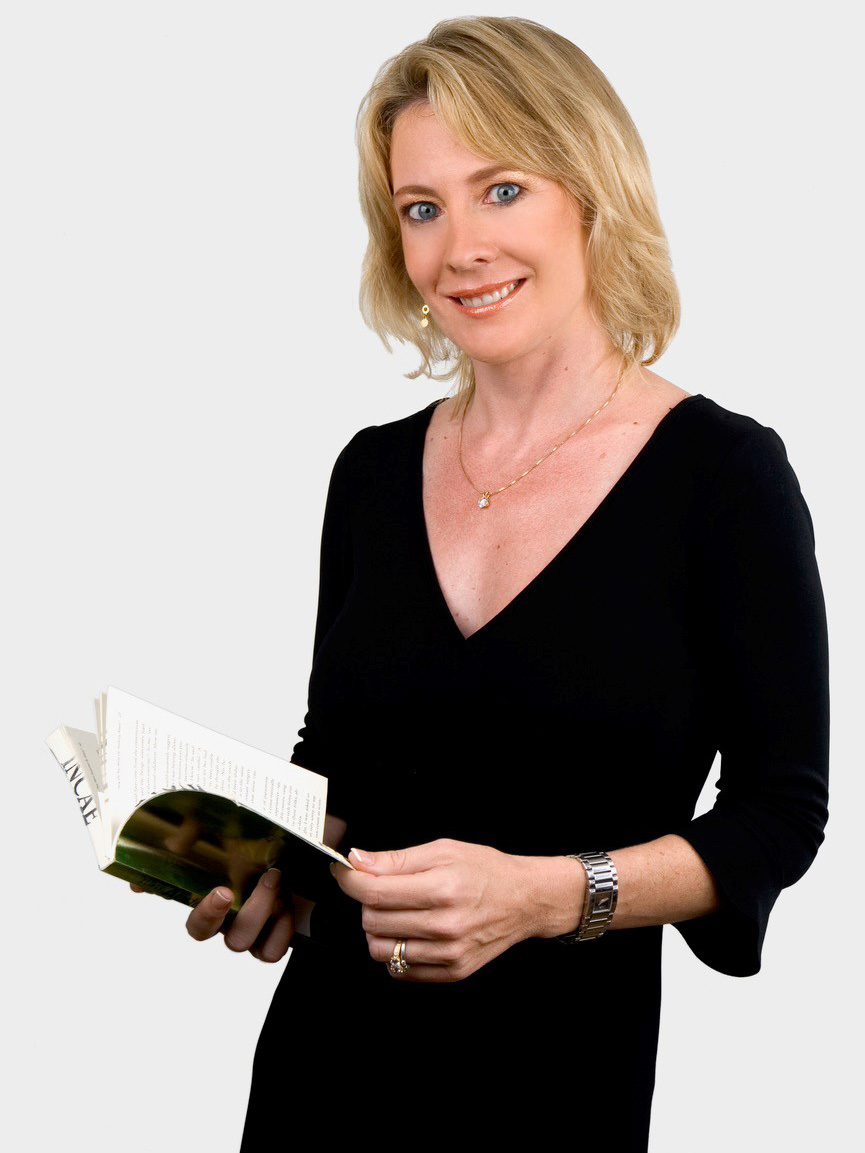
Susan
A. Clancy
Biography
Prof.
Clancy is renowned as an expert in topics of gender diversity
and women leadership. She has succeeded in a predominantly
male environment.
She
has a Ph.D. in Experimental Psychology from Harvard University,
where she was a Faculty member. At INCAE, she is a professor
and Research Director of the Center for Women’s Leadership.
She
has presented at numerous conferences and training programs
at multinational companies like Coca-Cola, INTEL, General
Mills, HP, P&G, and HSBC. At the same time, she has
lectured in governmental institutions in Latin America and
International Development Organizations such as IDB and
SDR (BID, DEG, Spanish acronyms). She has had multiple media
appearances in CNN, Larry King Live and Dateline, and has
been interviewed by the Wall Street Journal, the New York
Times, which have noted her research.
Work
Experience
Prof.
Clancy is renowned as an expert in topics of gender diversity
and women leadership. She has succeeded in a predominantly
male environment. She has a Ph.D. in Experimental Psychology
from Harvard University, where she was a Faculty member.
At INCAE, she is a professor and Research Director of the
Center for Women?s Leadership. She has presented at numerous
conferences and training programs at multinational companies
like Coca-Cola, INTEL, General Mills, HP, P&G, and HSBC.
At the same time, she has lectured in governmental institutions
in Latin America and International Development Organizations
such as IDB and SDR (BID, DEG, Spanish acronyms). She has
had multiple media appearances in CNN, Larry King Live and
Dateline, and has been interviewed by the Wall Street Journal,
the New York Times, which have noted her research.
Clancy
appeared in the 2005 documentary UFOs: Seeing is Believing,
and in a Discovery Channel Show, Conspiracy Theory, in 2007.
Susan
Clancy presenting evidence for alien abductions under hypnosis:
https://www.youtube.com/watch?v=A85CRsmPaOM
A
presentation by Susan Clancy who wrote the book entitled
Abducted: How People Come to Believe They Were Kidnapped
by Aliens
https://www.youtube.com/watch?v=Yx8zGRUjf8Y
_______________
A
Review of Susan Clancy's book, Abducted: How People
Come to Believe They Were Kidnapped by Aliens by
David M. Jacobs, Department of History, Temple
University, Philadelphia, PA
http://www.ufoabduction.com/clancyreview.htm
|
|
| |
| |
|
No infringement intended. For educational
purposes only.
|
|
|